Why Cheap Beds Form Craters
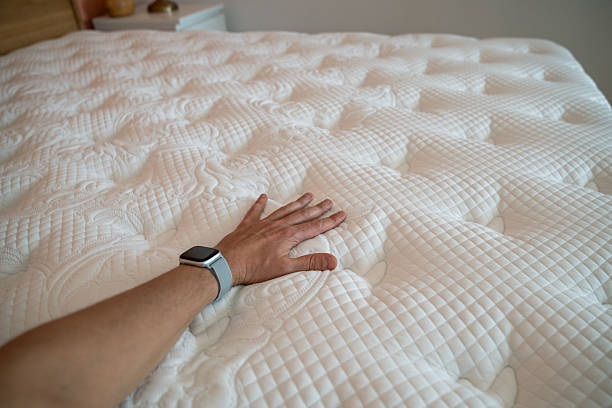
Let’s start with the most common culprit: foam density. Most budget mattresses use polyurethane foam that is cut with a lot of air and little material. Think of it like cheap bread. A fluffy, cheap loaf looks good in the store, but the moment you press on it, it compresses flat and never springs back. High-density foam, by contrast, is packed tightly with polyurethane cells and often reinforced with memory foam or latex. That dense structure resists the constant pressure of your body weight. When you sleep on a cheap foam mattress, your body heat and weight slowly break down those fragile foam cells. After a few months, the foam loses its ability to rebound. You are not just sagging the mattress; you are permanently crushing the material. The result is a crater that never goes away, no matter how much you fluff it.
Next, consider the coil system. Many cheap innerspring mattresses use what are called “continuous coils” or “open coils.“ These are long wires that are bent into a series of springs, all connected in a single row. The problem is that these coils are not individually wrapped. They twist and pull on each other. When you lie down, your body weight presses on several coils at once. Over time, the metal fatigues. It loses its ability to push back. Worse, because the coils are interconnected, a sagging spot on one side of the bed can pull down coils on the other side. Better mattresses use individually pocketed coils. Each spring is encased in its own fabric pocket, so it moves independently. If you sag one coil, the others stay firm. Cheap beds skip this engineering because it costs more. They rely on a single, long wire that is much cheaper to manufacture. That wire will eventually bend permanently under your hips or shoulders, creating a crater that mirrors your sleep position exactly.
Then there is edge support. Have you ever sat on the edge of a cheap bed? You probably felt like you were sliding off a cliff. That is because budget mattresses typically have no reinforced perimeter. They use the same low-density foam and weak coils right up to the edge. Over time, the constant stress of sitting on the side, or even just rolling near the edge, causes the materials to collapse. This edge sagging makes the entire mattress feel smaller and less stable. It also accelerates core sagging. Without solid edges, the center of the mattress takes more weight. A good mattress has a high-density foam encasement around the entire perimeter or a thicker gauge coil ring. Cheap beds cut this corner entirely.
Finally, don’t overlook the mattress foundation. Many people buy a cheap mattress and then put it on a cheap, slatted frame with wide gaps or a weak box spring. The mattress needs even support underneath. If the slats are too far apart, the mattress will dip into the gaps, creating a sagging pattern that mimics a crater. Even a good mattress will fail quickly on a bad foundation. Cheap mattresses are especially vulnerable because they have less structural integrity to begin with. The combination of low-density foam, weak coils, poor edge support, and an inadequate base is a recipe for a sleeping surface that looks like a desert landscape after a meteor shower.
So what should you do? If you currently have a cheap bed with craters, the fix is a new mattress. Look for one with foam densities of at least 1.8 pounds per cubic foot for polyurethane, or 4 pounds for memory foam. Choose individually pocketed coils with a thick steel gauge. And make sure your foundation is solid, with slats no more than three inches apart. Investing a bit more up front saves you from the misery of rolling into a crater every night. Your spine, your hips, and your sleep quality will thank you. Remember, a bed is not a place to cut corners. It is where you rebuild your entire body each night. Give it the support it deserves, and you will wake up feeling like you actually slept, not like you wrestled with a sinkhole.
Dream Blog
Real sleep talk for real people.


Bathroom Nightlights That Protect Melatonin

The Zero Sheets Hammock Bed